The RenOlympics: A Card-Based Game for Just Renovation Decisions

A toolkit to bring residents' needs into the heart of renovation choices

In residential renovation, decisions are often dominated by technical and financial considerations, while residents' everyday concerns — comfort, affordability, health, accessibility, recognition of diverse household practices — remain in the background. Through Just Prepare, we developed a card-based serious game, the RenOlympics, together with a set of supporting materials, to help professionals, researchers, and policy actors reflect on how justice can be integrated into renovation decision-making from the earliest design phase.
 
The toolkit was used in two co-creation workshops in 2026, bringing together municipalities, housing associations, designers, consultants, resident advocates, and researchers. Participants were invited to challenge current renovation practices and to centre residents' needs and concerns in every choice they made during the game.
What the toolkit contains

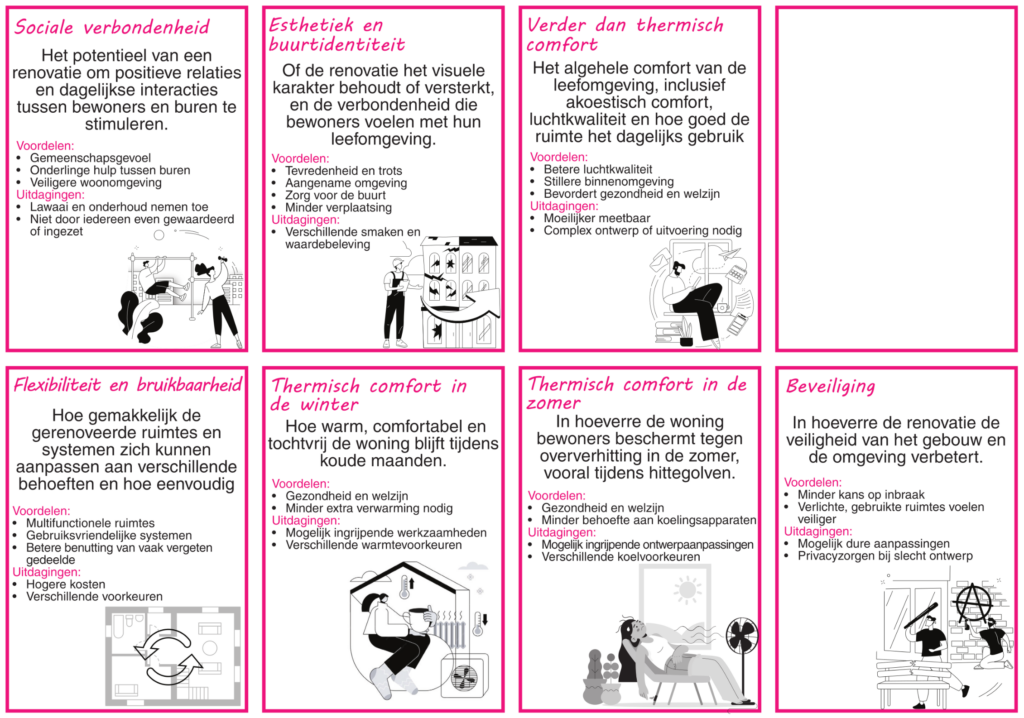
  • Decision-making criteria cards: 19 cards representing socio-technical criteria for renovation, grouped into liveability, cost, environmental impact, and construction impact.
  • Intervention cards:  24 cards representing concrete renovation measures at the dwelling, building, and neighbourhood scale.
  • Vulnerability-context vignettes: five resident-centred scenarios depicting recurring vulnerabilities in Dutch social housing, from energy poverty to social isolation, grounded in fieldwork and direct resident quotes.

  • Justice Wheel: a visual evaluation framework structured around recognition, procedural, and distributive justice.
  • Individual ranking sheet: a personal worksheet completed before and after the workshop to capture how participants' priorities shift through collective deliberation.
  • Facilitator guide:  workshop structure, game rules, and guiding questions.

A further refinement of the game/workshop was made by introducing initial use cases from which participants can select scenarios representing critical situations (vignette-type households or neighbourhood characteristics). These provide a more concrete reference point that helps participants prioritise criteria (cards) and co-create renovation scenarios. This process then feeds into a discussion on justice based on the developed scenarios.

For example, the use cases may represent conditions of severe energy poverty, material or physical deficiencies at the building and neighbourhood level, overheating stress during summer, and a lack of social connection, including isolated neighbourhoods.

Why we share this

We believe that translating energy justice from an abstract principle into a concrete practice requires accessible, hands-on tools that can be picked up and adapted by others. The materials below are freely available for use in workshops, training sessions, and educational settings. We hope they support practitioners and researchers in starting conversations that put residents' lived experience at the centre of renovation decisions.

Picture of Diletta Ricci

Diletta Ricci

PhD at Technical University Delft

Share?