Summary
Energy justice is not a fixed standard to be applied uniformly. It is a lens for asking better questions about renovation decisions: Who benefits? Who bears the burden? Whose needs are being recognised? Who has a meaningful say?
Three deeply entangled dimensions help structure these questions:
- Recognition justice: acknowledging the diversity of residents’ needs, living conditions, and identities, including those that are rarely visible in technical assessments
- Procedural justice: ensuring that residents and relevant stakeholders can participate in decision-making in a transparent, timely, and accessible way
- Distributive justice: attending to how the benefits and burdens of renovation, comfort gains, cost increases, construction disruption, long-term savings, are distributed across residents
These three dimensions emerge from academic literature and serve as an analytical starting point, not a normative prescription. They do not define what justice should look like in a given situation. What actually constitutes justice in practice is inherently situated: it emerges from the specific social, spatial, and material conditions of each neighbourhood, and from the claims and priorities of those directly affected. Local knowledge, resident experiences, and practitioner insights may confirm, nuance, or even challenge what these dimensions suggest. The framework is therefore designed to be complemented and grounded by what emerges locally; some aspects will resonate strongly in a given context, others may be less relevant or need to be reframed entirely.
What follows from this?
The Justice Wheel for Housing Renovation (Figure 1) is the central framework of this guide. It makes the three justice dimensions operational by translating them into fifteen concrete criteria for renovation design and decision-making. These criteria are organised across the three interconnected dimensions of the wheel:
- Recognition) what needs to be seen and acknowledgedà Socioeconomic situation of households, Local social networks, Health and wellbeing, Living comfort, Cultural values
- Procedural) how the process is designed and governed à Use of local input and indicators, adoption of a accurate building diagnosis, Effective resident influence and empowerment, Impact of the construction process on residents, Quality assurance
- Distributive) how costs and benefits are shared à Long-term benefits, Financial consequences for residents, Flexible and adaptable solutions, Design that goes beyond energy performance alone, Reduction of energy consumption and environmental impact
How to use the framework?
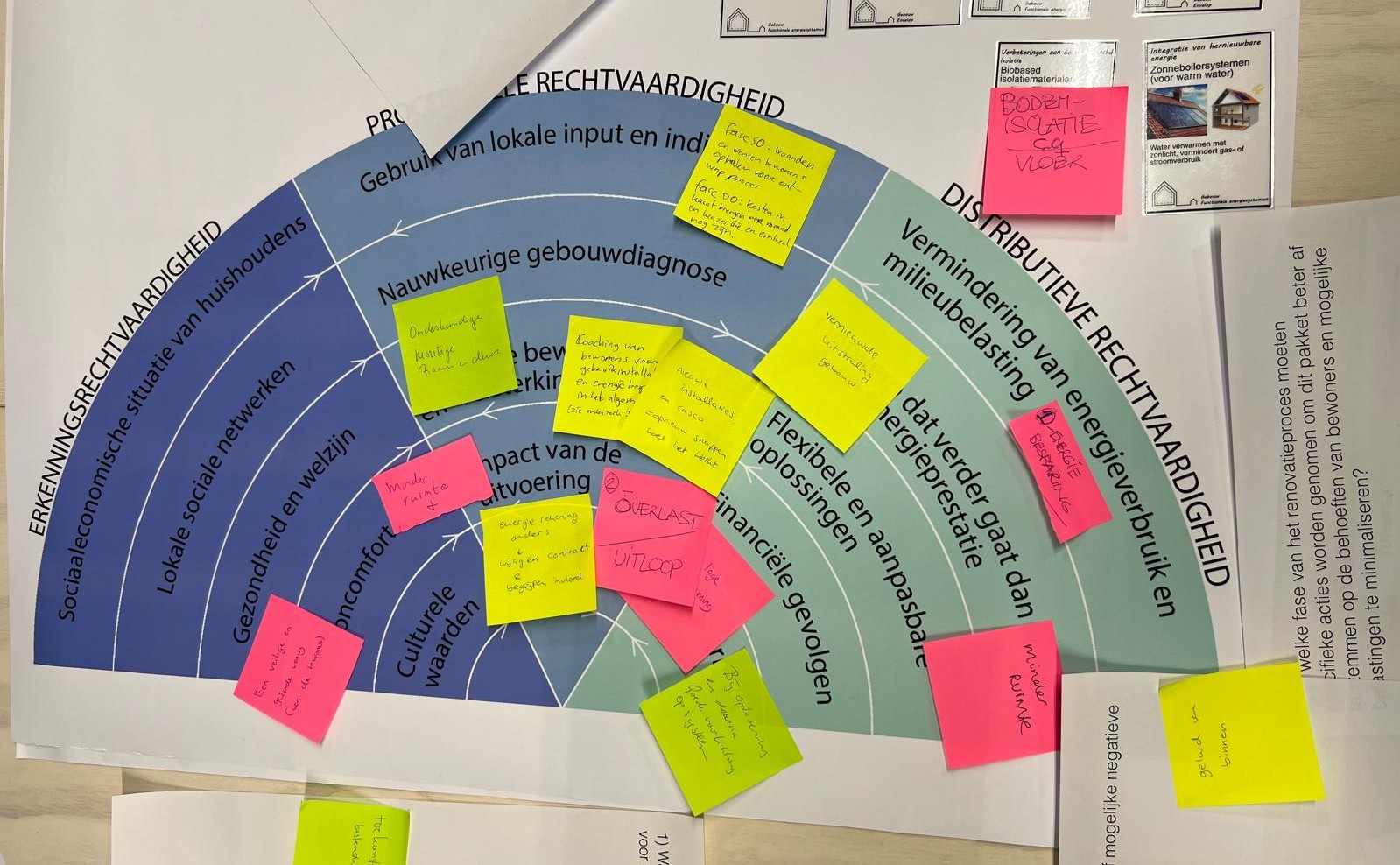
The wheel in Figure 1 is most useful as a starting point for decision-making guidelines and assessment method, among stakeholders with different roles and knowledge levels who have an influence on renovation decisions. When used in a stakeholder session or workshop, the wheel gives participants from different backgrounds — residents, housing associations, municipalities, advisors – a shared structure to articulate priorities, surface disagreements, and explore trade-offs. Rather than prescribing answers, it prompts the right questions at the right stage of the process.
The criteria are not meant to be applied in a fixed order. Some will be immediately actionable; others may serve as prompts for further investigation or negotiation. Over time, through use in a specific context, the general framework can evolve into a more tailored instrument, closer to a working checklist, that reflects the particular priorities and conditions of that setting.
 NL
 EN